 By SRTeam
 Tennis looks smooth on television, but the sport is brutal on the body. Every rally asks for acceleration, deceleration, rotation, shoulder speed, grip strength, hip control and repeated changes of direction. Over time, the load builds up in the elbow, wrist, shoulder, knees, Achilles tendon, hips and lower back.
That is why recovery has become a serious topic in tennis. Players at every level want to train harder, recover faster and stay on court longer. As a result, more tennis players and sports fans are searching for peptides like TB-500.
The search trend is real. The evidence needs careful handling.
TB-500 is often discussed in sports recovery circles, but it is not a proven tennis-recovery product. It is a research peptide related to Thymosin Beta-4 biology, and most of the evidence behind the discussion is preclinical. That means laboratory studies and animal models, not confirmed injury-recovery outcomes in tennis players.
Why tennis creates so much recovery stress
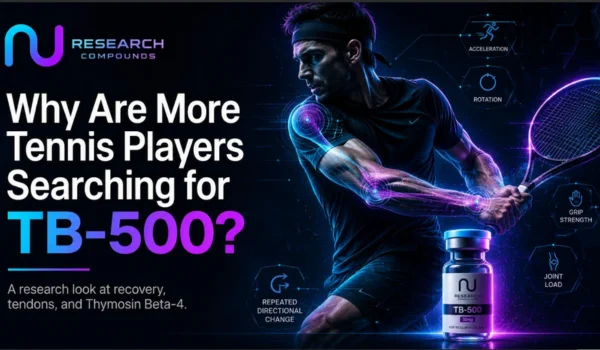
Tennis is not one movement. It is hundreds of short bursts layered on top of rotation and repetition.
A serve loads the shoulder, spine, hip and abdominal chain. A forehand uses trunk rotation and repeated shoulder acceleration. A backhand can load the wrist, elbow and shoulder in different ways depending on technique. Lateral movement stresses the knees, ankles and groin. Hard courts increase impact. Clay extends rallies. Grass can challenge stability.
That combination explains why tennis recovery searches often include:
- tendon recovery
- elbow pain
- shoulder recovery
- Achilles tendon soreness
- knee inflammation
- muscle repair
- peptides for recovery
- TB-500 tennis recovery
- BPC-157 and TB-500
The language of tennis injuries overlaps with the language used in peptide research. That overlap is why TB-500 keeps appearing in search results.
What is TB-500?
TB-500 is a synthetic peptide fragment related to Thymosin Beta-4. Thymosin Beta-4 is a naturally occurring peptide involved in actin regulation, cell migration and tissue-response biology. TB-500 is not the same as natural Thymosin Beta-4. It is a synthetic fragment discussed in research settings.
This distinction matters. Online content often uses TB-500 and Thymosin Beta-4 as if they are identical. They are related, but they are not the same thing.
Peptides are short chains of amino acids. Some peptides act as signaling molecules. Some are used in laboratory research. Some have approved medical roles. Others are discussed in sports and recovery communities despite limited human data.
TB-500 belongs in the research-compound conversation, not in the category of proven sports treatments.
Why TB-500 became popular in sports searches
TB-500 became popular because the keywords around it match what athletes care about: repair, mobility, tissue response, tendons, recovery and training continuity.
Tennis players are especially interested because tennis injuries are often not simple one-time events. Many are load-management problems. A player may feel fine for one session, then struggle after repeated serving, long rallies or back-to-back matches. That makes recovery strategy part of performance.
When athletes search for ways to stay on court, they find discussions about peptides. TB-500 appears in those discussions because of its relationship to Thymosin Beta-4 and tissue-repair research.
But search popularity is not clinical proof.
What does the research say?
The research conversation around TB-500 comes mostly from studies on Thymosin Beta-4 and related fragments. Researchers have looked at cell migration, tissue-repair signaling, wound-response biology, angiogenesis and recovery processes in different tissue models.
These areas are interesting, especially for sports science. They help explain why researchers might study the pathway further. They do not prove that TB-500 repairs a tennis elbow, fixes an Achilles tendon or shortens return-to-play time.
That is the most important point for athletes.
Preclinical evidence can generate hypotheses. It cannot be treated as a confirmed protocol for human performance or injury recovery. A laboratory signal is not the same as a controlled clinical trial in tennis players.
Is TB-500 banned in sport?
Yes. Athletes need to understand the anti-doping side of this topic.
TB-500 and related Thymosin Beta-4 analogues are prohibited in sport under anti-doping rules. For players subject to testing, this is not a minor detail. It matters in competition and out of competition.
Any tennis player competing under a tested framework should treat TB-500 as off-limits. The same applies to many other research peptides that fall under non-approved substances or related prohibited categories.
This is where sports content must be clear. A compound being discussed online does not mean it is allowed. A compound being sold as a research chemical does not mean an athlete can use it. A compound lacking approval can create both health and eligibility risks.
TB-500 vs BPC-157 in recovery conversations
TB-500 is often mentioned with BPC-157. The two peptides are usually grouped together in forums, but they are not the same.
BPC-157 is a synthetic peptide discussed in preclinical tissue-repair and gastrointestinal research. TB-500 is a synthetic fragment related to Thymosin Beta-4 and cell-migration biology. Both are heavily discussed in recovery circles. Both lack robust human clinical evidence for general sports recovery. Both create anti-doping concerns for athletes.
For tennis players, that means the better conversation is not “which peptide works better?” The better question is “what does the evidence actually show, and what are the regulatory risks?”
That question is less flashy, but it is far more useful.
Why recovery basics still matter most
The rise of peptide searches should not distract from the foundations of tennis recovery.
Load management, coaching, mobility work, progressive strengthening, sleep, hydration, nutrition and medical assessment remain the first layer. A player with recurring elbow pain needs technique review, grip assessment, racket setup, volume management and proper clinical evaluation. A player with Achilles pain needs progressive loading and professional guidance. A player with shoulder pain needs more than a trending compound name.
Peptide research may be interesting, but it does not replace sports medicine.
Why testing and COAs matter in peptide research
Even in a laboratory setting, peptide quality matters. Research compounds should be supported by batch-specific Certificates of Analysis. That means identity confirmation, purity testing, lot traceability and clear documentation.
For peptides like TB-500, poor sourcing can create major problems. If a material is mislabeled, impure or unverified, the research built around it becomes unreliable. That is why serious peptide suppliers emphasize HPLC purity, mass spectrometry and transparent COA access.
For a deeper research-first breakdown, New-U has a TB-500 and Thymosin Beta-4 overview explaining the difference between the peptide, the parent molecule, the evidence limits and the anti-doping context.
The bottom line
More tennis players are searching for TB-500 because tennis is a high-load sport and recovery is part of performance. The keyword trend makes sense. The science needs better framing.
TB-500 is a research peptide related to Thymosin Beta-4 biology. It is discussed in connection with cell migration and tissue-repair research, but most of the evidence is preclinical. It is not a proven tennis-recovery treatment, and it is prohibited under anti-doping rules for tested athletes.
Tennis players should be careful with any content that turns peptide research into human-use promises. The smarter approach is to understand the science, respect the evidence limits and keep recovery decisions grounded in qualified sports medicine.
Research compounds are intended for laboratory research use only. Not for human or veterinary consumption.
FAQs
Why are tennis players searching for TB-500?
Tennis players search for TB-500 because the sport creates heavy recovery demands, especially around tendons, joints, shoulders and repeated match load. Search interest does not prove human benefit.
Is TB-500 a peptide?
Yes. TB-500 is a synthetic peptide fragment related to Thymosin Beta-4. It should be described as a research peptide, not a proven sports treatment.
Is TB-500 allowed in tennis?
No for tested athletes. TB-500 and related analogues are prohibited under anti-doping rules. Competitive players should treat it as banned.
Does TB-500 repair tendons?
There is preclinical research around Thymosin Beta-4 biology and tissue-response pathways, but TB-500 is not proven as a tendon-repair treatment in tennis players.
What should tennis players focus on first for recovery?
Training load, technique, sleep, nutrition, hydration, mobility, progressive strengthening and professional sports-medicine guidance should come first.